


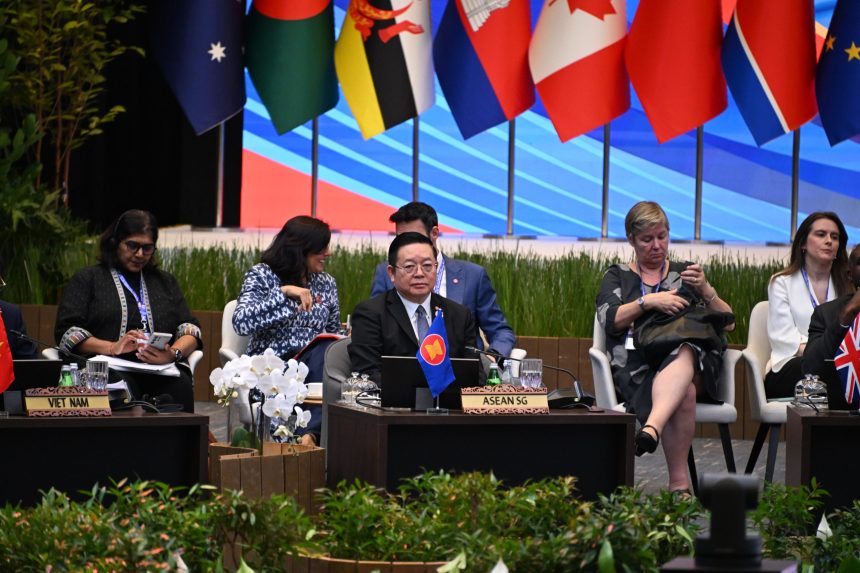
As the ASEAN foreign ministers gathered recently to set the agenda of the bloc in 2026, the familiar critique of ASEAN’s slow, divided, and incapable nature to react to the emergent problems, whether it is the Myanmar civil war or the South China Sea, resurfaced. With the growing US-China conflict, ASEAN further faces allegations of being strategically irrelevant.
This view, however, misses the point. ASEAN was not designed to resolve the great-power conflict or accomplish a collective action. Its actual function has been to manage competition without coercing conformity. So, what appears as ASEAN’s weakness is, in fact, a rational survival tactic of Southeast Asia, a region characterized by the unequal balance of power and unpredictable geopolitical situation.
Southeast Asia has a potent place in world politics. It is positioned at the most critical maritime routes, like the South China Sea and the Malacca Strait, and actively contributes to global arenas of supply chains. It is an economically dynamic yet politically diverse region, encompassing democracies, authoritarian regimes, and hybrid regimes, US allies, and states that are integrated with the Chinese economy. In such a heterogeneous region, rigid adherence to one power would be disruptive.
That is why ASEAN’s preference for consensus, non-binding commitments, and institutional flexibility is not accidental. It reflects Southeast Asia’s structure, in which states can barely afford exclusive security promises without jeopardizing their autonomy. Therefore, hedging and not alignment is the default strategy of ASEAN. Besides, ASEAN’s institutional design is such that it allows engagement with multiple powers while avoiding commitments that would polarize the region.
In this respect, ASEAN does not mediate the great-power rivalry but rather determines the circumstances within which that competition occurs. By employing an inclusive regional diplomacy with managed strategic ambiguity, ASEAN prevents external competition from hardening into rigid blocs. is solidified in hard pacts by maintaining local diplomacy as open and the results ambiguous. The result is Southeast Asia’s managed competition that has enough room for all actors to maneuver.
This has been evident in the intensifying US-China rivalry across Southeast Asia. The region has become one of the most decisive grounds of their competition, not only due to its geography but also due to its widening role in the digital markets, infrastructure development, and technological norms. ASEAN allows Washington and Beijing to confront each other with competing initiatives on connectivity, supply chain resilience, and digital governance without outright confrontation.
Nevertheless, both the powers continue to invest in the ASEAN-based platforms since their involvement in ASEAN brings legitimacy, access, and signalling chances with a maintained flexibility. Instead of getting marginalized by the great-power competition, ASEAN has transformed itself into the institutional space where the great-power rivalry is being tamed.
The same argument applies to the other regional rivalries. The rivalry between Japan and China is an example of economic and technological engagements rather than direct strategic contestation. Tokyo’s investments in quality infrastructure, digital standards, and capacity-building projects enable it to compete with Beijing without escalating tensions. It is through ASEAN’s institutional environment that this type of restrained competition is enabled.
ASEAN’s policy is founded on selective engagement that is adjusted to maintain autonomy while avoiding retaliation. ASEAN’s non-institutionalized alignment allows its members to derive economic and strategic benefits from various partners simultaneously, enabling Southeast Asia to remain an opportunity zone, rather than a frontline confrontation region.
The usefulness of such an approach is increasingly evident in the Indo-Pacific since the region battles with strategic polarization. Institutions capable of absorbing competition without any formal institutionalization are rare. ASEAN’s relevance does not lie in solving great power competition or wiping out underlying conflicts but in preventing rivalry from becoming uncontrollable.
As strategic polarization deepens across the Indo-Pacific, the value of such an approach is becoming more apparent. Institutions capable of accommodating rivalry without formal alignment are increasingly rare. ASEAN relevance does not lie in solving great-power competition or eliminating underlying disputes but in preventing rivalry from becoming uncontrollable.
The threats and risks associated with ASEAN hence appear well-founded and real. The absence of a widely recognized regional architecture would tend to make Southeast Asia’s competition more localized and combative, especially in the areas of maritime security, emerging technologies, and digital governance. The lack of ASEAN’s inclusive mechanisms would not bring clarity but rather disintegration.
Critics fail to put ASEAN in realistic measure and evaluate it based on its failure to produce decisive results instead of its ability to maintain a balance in an asymmetric environment. Slow and largely ineffective as it may appear, ASEAN remains one of the few mechanisms capable of receiving strategic pressure without amplifying it.
It is not whether or not ASEAN’s model works, but whether it can survive in a world where great powers are willing to coerce as opposed to persuade. Southeast Asia would be left with little option but to make decisions it has avoided making in decades in case the ASEAN model collapses. By sustaining ambiguity, ASEAN has helped Southeast Asia avoid being the victim of the great-power rivalry, the greatest contribution of ASEAN in a fractured international system.
Hiba Malik
The author is Assistant Manager Research at the NUST Institute of Policy Studies (NIPS) and holds a Master’s degree in Peace and Conflict Studies from the Centre for International Peace and Stability (CIPS), NUST. Her research interests include great power competition, South Asia, the Middle East, and International Humanitarian Law. She can be reached at hibaaqmalik[at]gmail.com. (ORCID ID: https://orcid.org/0009-0002-2455-6559)