


Strategic competition over Artificial Intelligence (AI) has intensified among the technologically advanced major powers, particularly between the US and China. While major power rivalry is not new, what sets the AI race apart is its novelty — its transformative potential in reshaping modern lives and the unprecedented pace of its development. Hence, the stakes of AI development are too high for it to be shaped primarily by the dynamics of major power rivalry. Relevant AI models should incorporate cultural diversity and the aspirations of developing nations.
As the US-China rivalry precipitates technology bifurcation, Japan and ASEAN are exploring alternative approaches to AI cooperation, one which can be inclusive and holistic. Although these approaches do not offer a complete replacement, pragmatic albeit suboptimal solutions can provide a strategic buffer, helping them avoid the direct effects of great-power competition, at least temporarily.
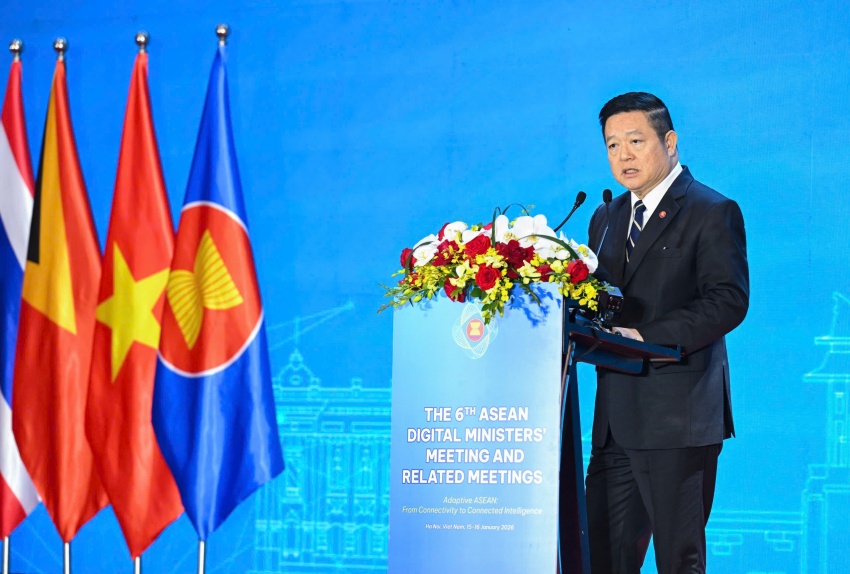
This was most evident in the recent 6th ASEAN-Japan Digital Ministers Meeting, where both sides affirmed their commitment to building AI development grounded in culturally responsive innovation. The ministers recognised the need to include cultural nuances in AI models to better reflect an ecosystem that is genuine to local realities. Without this, AI will continue to be shaped largely by the values of technologically advanced societies such as the US or China, which entail particular cultural biases and norms. This builds on Japan’s proposal for the ASEAN-Japan AI Co-Creation Initiative, which envisions collaboration in AI to advance economic prosperity and security by cultivating local talent and resilience, rather than relying on foreign models.
The term “co-creation” has become a key buzzword in ASEAN-Japan relations. This concept was formally introduced in the Joint Vision Statement on ASEAN-Japan Friendship and Cooperation issued in December 2023 to mark the 50th anniversary of ties. While initially framed within the context of socio-economic cooperation, the concept of co-creation reflects a broader shift in the partnership towards inclusive and mutual growth as equal partners. It acknowledges the reality that several ASEAN member states have advanced economically to the point where cooperation with Japan has become increasingly reciprocal. In addition, intensifying great power rivalry has pressured small and middle powers to expand their strategic options through coalition-building.
The principle of an “equal partnership” is not new. The 1977 Fukuda Doctrine — in which Japan sought to reconcile with Southeast Asia by pledging mutual understanding and vowing that it would not become a military power — similarly emphasised the importance of equality between Japan and ASEAN. Yet at the time, cooperation was largely framed within an assistance-oriented, provider–recipient context. In this sense, the 2023 declaration represents a significant step in the long-term evolution of ASEAN-Japan relations, aligning partnership with collective strength and a focus on innovation.
Although technological cooperation is not new to the ASEAN-Japan partnership, the explicit mention of AI was first featured in the ASEAN-Japan Digital Work Plan for 2025 on the safe use and development of AI. The work plan also acknowledged the need for linguistic and cultural diversity in AI development and applications, a theme that continues to shape ASEAN-Japan AI cooperation today.
Within ASEAN, some member states have been proactive in building sovereign AI models, such as Singapore’s SEA-LION, Malaysia’s Intelek Luhur Malaysia Untukmu (ILMU), and Indonesia’s Sahabat-AI. Regional frameworks on AI have also taken shape in recent years, including the ASEAN Guide on AI Governance and Ethics adopted in 2024 and the ASEAN Responsible AI Roadmap (2025-2030). Both initiatives aim to promote the safe and responsible use of AI while fostering interoperability, reflecting the growing recognition that AI development and governance should be developed with a regional and global framework in mind.
Similarly, Japan’s AI strategy reinforces an outward-looking orientation. The AI Basic Plan released by the Cabinet in December 2025 underscores that Japan’s AI ambitions cannot be realised in isolation. Instead, the plan recognises that international cooperation with ASEAN and other Global South partners is integral to building a resilient, inclusive and trusted AI ecosystem, one that reflects respect for cultural diversity in AI development. This recognises that AI development has implications not only for technologically advanced countries but also for developing countries that may still be building the necessary capabilities. Despite the digital divide, inclusive participation is essential to the creation of a more equitable AI ecosystem.
This outward-looking approach was reinforced at the most recent ASEAN Summit, where Prime Minister Sanae Takaichi called for deeper joint research on frontier technologies and proposed the aforementioned ASEAN-Japan Co-Creation Initiative for AI. Rather than pursuing full technological self-sufficiency, the initiative seeks to secure a degree of AI autonomy by resisting domination by technologically advanced countries and co-creating a diverse and interoperable AI ecosystem that is capable of addressing socio-economic challenges. By promoting local AI ecosystems, ASEAN members and Japan are attempting to jointly shape AI development in a more balanced and resilient manner, reducing dependence on foreign models and external assistance.
One such recent example is the MOU signed between Japan and Cambodia to develop a large language model (LLM) with the Khmer language at the sidelines of the 6th ASEAN Digital Ministers Meeting. While modest in scale, it represents an important step to nurturing AI ecosystems which support linguistic and cultural diversity, especially with a developing country that may not have the resources to build its own model independently.
To be clear, these initiatives are no guarantee of AI autonomy. They remain in an early phase, even as technological change is moving rapidly. Nor is Japan alone in pursuing this agenda. For years, China has been actively collaborating with Southeast Asian countries on technology and AI through its Digital Silk Road initiative. While ASEAN-China technology cooperation is robust, there are concerns that this may result in some countries being overly dependent on the Chinese technology stack, especially amid geopolitical tensions across the tech sector. In this regard, Japan’s initiatives are welcome. They position Japan as potentially a more neutral partner in helping ASEAN build capabilities, and over time, exercise “practical agency in long-term technological advancements.”
How ASEAN and Japan co-create on AI offers a glimpse of an alternative path for AI cooperation. It will demonstrate whether meaningful agency in AI development can move beyond the confines of major power rivalry and the current bifurcation of AI. In doing so, the ASEAN-Japan partnership on AI offers insights into how both sides may engage with the wider Global South by harnessing co-creation.
Angeline Tan is an Analyst at the Institute of Strategic & International Studies (ISIS) Malaysia.
Kei Koga is Associate Professor and Head of Division at the Public Policy and Global Affairs Programme, School of Social Sciences, Nanyang Technological University (NTU). He is concurrently a Nonresident Fellow at the National Bureau of Asia Research (NBR), an independent research institution based in Seattle and Washington, D.C.